
MEMS Mirrors and the Evolution of Optical Switching in AI Data Centers
 May 28, 2026
Sheldon McLaughlin
Distinguished Technical Staff

Why the Optical Layer Needs to Adapt
With AI networks continuing to scale, the demands placed on the optical layer inside the data center are changing fundamentally. Modern AI clusters require not only massive bandwidth, but also the ability to dynamically adapt network connectivity as workloads, traffic patterns, and cluster architectures evolve.
Optical Circuit Switches (OCS) are emerging as an important technology for enabling large-scale, reconfigurable AI fabrics with lower power consumption and reduced network complexity. At the center of Lumentum’s OCS platform is a technology with decades of proven deployment in optical networking: MEMS mirrors.
While multiple technologies can be used to build optical switches, MEMS-based switching provides a unique combination of low optical loss, protocol transparency, scalability, and long-term reliability that is particularly well suited for evolving AI infrastructure.
What are MEMS?
MEMS (Micro-Electro-Mechanical Systems) are microscopic mechanical devices fabricated on silicon wafers using manufacturing processes derived from the semiconductor industry. In Lumentum’s OCS products, MEMS technology is used to build arrays of tiny tilting mirrors that precisely steer optical beams between fibers.
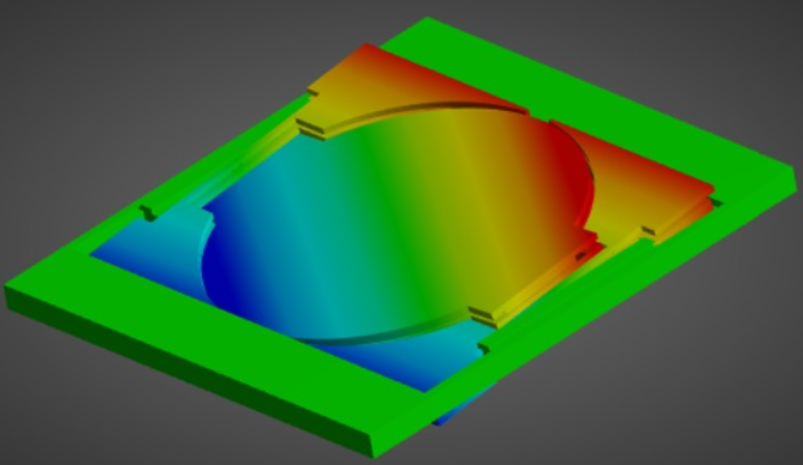
Image: Tilting MEMS mirror element from Lumentum’s OCS
Photolithography and silicon etching processes are used to fabricate both the mirror structures and the electrostatic actuators that control mirror motion. Because MEMS devices are built using wafer-scale manufacturing techniques, they can achieve extremely high precision, repeatability, and scalability.
Proven in Optical Networks
Lumentum began developing MEMS-based optical switches in the late 1990s, and Lumentum MEMS-based 1xN Wavelength Selective Switches (WSS) have been widely deployed in telecom ROADM networks since the mid-2000s. To date, Lumentum has shipped more than 150,000 MEMS-based WSS modules into telecom and hyperscale metro and long-haul optical networks, accumulating over one trillion (10¹²) mirror-hours of field operation.
After more than two decades of WSS market leadership, Lumentum has applied this extensive experience in high-reliability MEMS mirror design and scalable optical subassembly manufacturing to MEMS-based Optical Circuit Switches for AI data centers.
Why MEMS Matters for OCS
MEMS mirrors enable high-performance OCS with very low insertion loss (typically IL <1.5 dB without amplification) and broadband operation, supporting O-, C-, and L-band transmission within a single switching platform. Careful engineering of Lumentum’s MEMS mirrors also makes them highly resistant to industry-standard data center shock and vibration environments.
Lumentum MEMS-based OCS products introduce minimal signal impairments, with high optical return loss (ORL), strong port isolation, and very low polarization dependent loss (typically PDL <0.1 dB). This optical transparency is one of the key advantages of MEMS-based switching architectures.
Because the optical switching function is fundamentally protocol- and modulation-format agnostic, the same MEMS OCS platform can support current and future optical interfaces without requiring changes to the switching fabric itself. Lumentum’s OCS can support O-band DR and FR optics, future co-packaged optics (CPO) and Coherent Lite architectures for scale-up and scale-out AI networks, as well as C- and L-band coherent ZR/ZR+ interconnects for scale-across and data center interconnect (DCI) applications.
As optical interface technologies continue to evolve, MEMS-based switching provides a stable optical infrastructure layer capable of supporting future generations of data rates, wavelength multiplexing schemes, modulation formats, and bidirectional transmission architectures.
MEMS technology also scales efficiently into large radix optical switches. An NxN MEMS switch requires 2N mirrors — one for each input and output fiber — resulting in linear scaling with switch radix. In contrast, the number of individual Mach-Zehnder Interferometer (MZI) switching elements in a typical non-blocking silicon photonic switch architecture scales approximately with N², making very large radix implementations increasingly complex.
How the Switching Works
The MEMS chip inside a Lumentum OCS contains an array of hundreds of sub-millimeter-scale mirrors, each suspended by torsional hinge structures. Control voltages applied to electrodes near each mirror generate electrostatic forces that tilt the mirrors with precise angular control in two axes.
Light from each fiber is collimated by a microlens array and directed toward a corresponding MEMS mirror. Establishing a connection between two fibers requires coordinated actuation of two mirrors: the input mirror steers the beam toward the selected output mirror, while the output mirror directs the beam into the destination fiber. This architecture enables strictly non-blocking optical connections between any input and output ports.
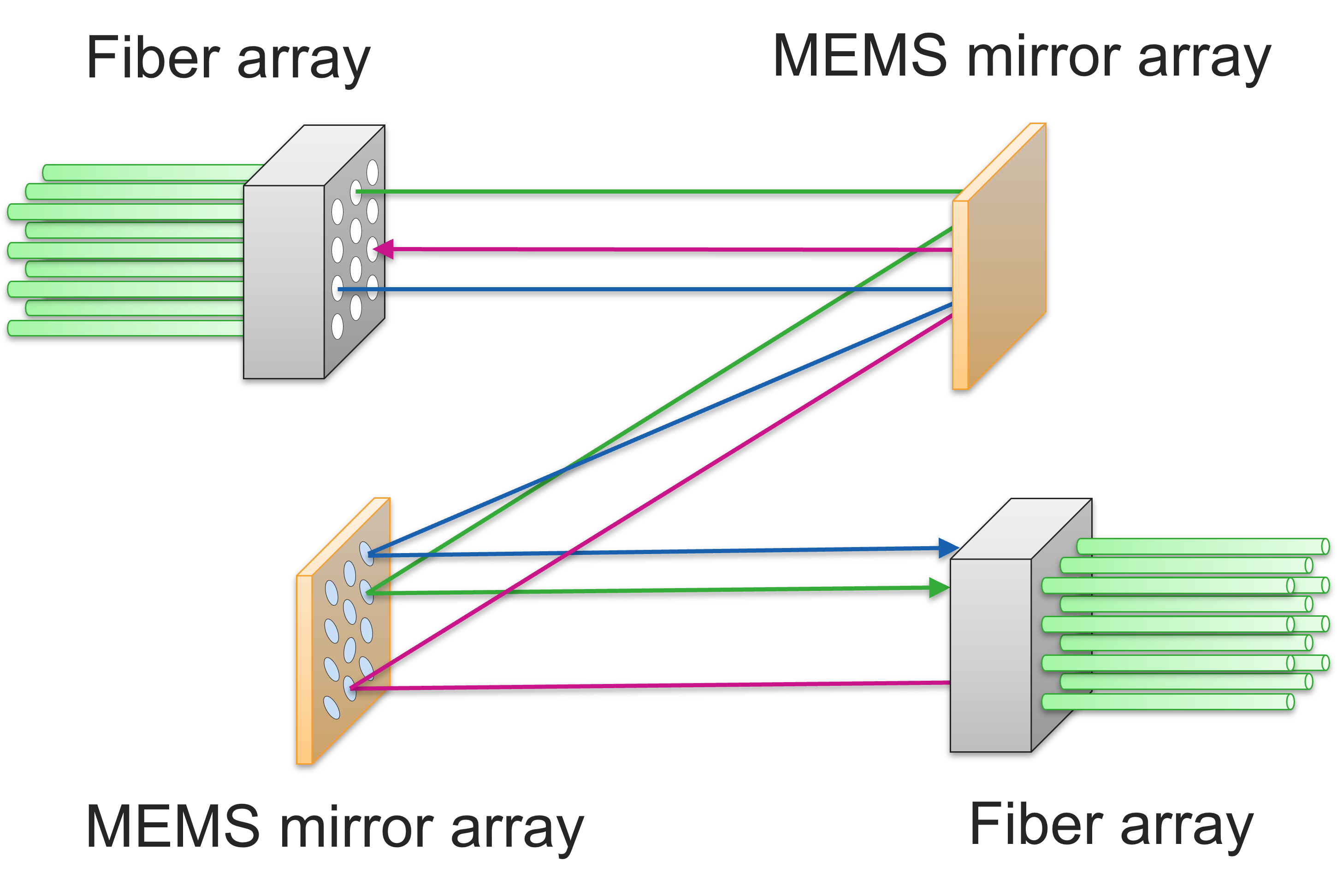
Image: Schematic of MEMS Optical Circuit Switch
Lumentum’s MEMS mirrors and hinge structures are fabricated from micro-machined single-crystal silicon, enabling highly repeatable actuation with extremely low hysteresis and strong resistance to wear-out, with testing demonstrating operation over hundreds of millions of switching cycles.

Image: Scanning electron microscope close-up of hinge structure from Lumentum’s WSS MEMS
Careful co-design of the MEMS mirrors and optical subassembly also enables highly stable mirror positioning across operating conditions and product lifetime, avoiding the need for complex active mirror feedback control mechanisms.
Conclusion: Scalable Optical Switching for AI Infrastructure
Lumentum’s MEMS-based OCS products build on decades of experience designing and manufacturing high-reliability optical switching technologies for large-scale optical networks. The combination of low optical loss, protocol transparency, scalable radix, and proven reliability makes MEMS particularly well suited for the evolving requirements of AI infrastructure.
As AI networks continue to scale and optical interfaces continue to evolve, MEMS-based optical switching provides a flexible and future-ready optical connectivity layer for next-generation data center architectures.
For more information, visit our Optical Circuit Switches page.