
Moving Gigabytes, Not Gigawatts: The Rise of AI Scale-Across Networking
 September 15, 2026
Christian Urricariet
Senior Director, Product and Strategic Marketing

AI infrastructure is entering a new phase. The industry conversation has largely centered on scale-up and scale-out: how to connect more accelerators inside a system, across a rack, or across large AI clusters within one data center. Those challenges remain critical, but another dimension is becoming increasingly important: scale-across.
Scale-across connects AI compute across multiple data centers, buildings, campuses, metros, or regions so distributed accelerator clusters can operate more like a larger, unified AI factory. It is not simply traditional data center interconnect with a new name. Traditional DCI was designed primarily to move data reliably between facilities. Scale-across must help operators pool AI infrastructure with high-capacity connectivity, predictable performance, high availability, and workload-aware management of latency, jitter, and congestion.
AI compute demand is growing faster than any single facility can absorb. Scaling is no longer only about how many GPUs can fit inside a rack or cluster. Increasingly, it is about whether enough power, cooling, land, fiber, permitting, grid capacity, and deployable optical infrastructure can be brought online fast enough in one location. AI infrastructure scales across a continuum, from optical connections close to the chip and rack to broader networks that connect compute across facilities (see Figure 1).
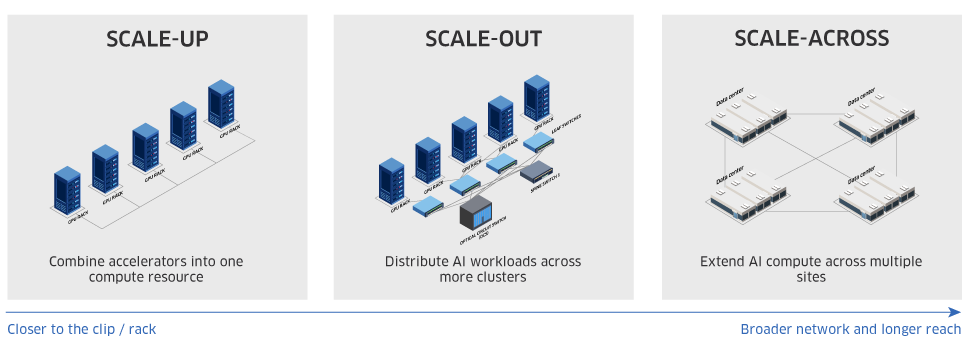
Figure 1 - Three ways AI infrastructure scales. AI systems scale from short-reach, high-density connectivity inside systems and racks to broader optical networks that connect distributed accelerator clusters across data centers, campuses, metros, and regions.
Let’s focus here on the right-hand side of that continuum: scale-across, where optical networking helps make distributed AI infrastructure usable despite power, cooling, land, and deployment constraints.
Power Is Becoming an Architectural Constraint
For decades, data center architecture was shaped by compute density, network bandwidth, cost per bit, and operational efficiency. Those metrics still matter, but AI has added a more physical constraint: power availability.
Modern AI clusters concentrate enormous electrical loads in small footprints. As operators plan larger training clusters and higher-volume inference infrastructure, the limiting factor is often the ability to deliver enough power, remove enough heat, secure land, and connect to the grid on the required timeline.
That changes the architecture discussion. If power cannot always be delivered fast enough to one site, AI infrastructure must become more distributed. Operators may need to pool resources across nearby buildings, multi-facility campuses, metro-area data centers, or longer-distance regions. In other words, it may be easier to move gigabytes than gigawatts.
Distance is not free. Latency still matters, and not every AI workload can be distributed efficiently across sites. But as power and construction timelines become more difficult, the network becomes a critical tool for making distributed compute usable.
Scale-Across Is More Than DCI
Traditional DCI has long supported storage replication, availability zones, backup, peering, content distribution, and workload migration. AI changes the role of those links.
Some training and inference architectures may use distributed pools of accelerators, storage, and services, but only when the workload can tolerate the added distance or when software and networking techniques can hide or manage the latency. For many scale-across use cases, bandwidth, availability, congestion control, and predictable performance will matter more than ultra-low latency.
Deployment models will vary across campuses, metros, and regions, supporting training, inference, resiliency, model distribution, data movement, and capacity pooling. In each case, the optical layer becomes more strategic as the AI system expands beyond one facility.
Optics Become the Enabler
As AI infrastructure expands across physical locations, optical networking makes distributed scale practical. Copper cannot solve this problem over campus, metro, or regional distances. Packet switching alone cannot solve it without careful attention to power, latency, congestion, and operational complexity.
Coherent pluggable modules such as 400ZR/ZR+, 800G-class ZR/ZR+, and emerging 1.6T-class variants enable high-capacity connectivity across data center, metro, and regional distances in compact form factors that can plug directly into routers and switches. Inside those modules are critical optical building blocks, including tunable lasers, coherent optical subassemblies, modulators, receivers, and photonic integration.
As capacity requirements grow, scale-across networks will also depend on more parallel fiber paths, denser line systems, and efficient optical amplification to move more traffic across constrained power and space envelopes.
Optical circuit switching adds flexible, low-loss connectivity for dynamically connecting high-capacity optical paths. Because MEMS-based optical switching can be transparent to protocol, modulation format, and wavelength band, it can support evolving optical interfaces without requiring the switching fabric itself to be redesigned every time the network changes.
Lumentum’s Role in Scale-Across
Lumentum supplies critical optical building blocks used in coherent DCI, metro, and long-haul networks, including high-performance ITLAs, TROSAs, and pump lasers for optical amplification. These components help enable the tunability, optical performance, integration, and reliability required as coherent optical links become foundational to scale-across AI infrastructure.
Lumentum’s MEMS-based optical circuit switching technology adds flexible, low-loss optical connectivity for O-band, C-band, and L-band applications across AI network architectures. For scale-across and DCI, it can support optical connections carrying coherent interconnects such as ZR/ZR+ links, while giving operators an optical switching layer designed to evolve with data rates, modulation formats, and network architectures.
Lumentum also brings deep experience in high-volume optical components, lasers, wavelength management/WSS, and photonic integration. As AI networks scale, the industry will need optical technologies that deliver performance, manufacturability, reliability, and power efficiency at hyperscale volumes.
The Architectural Takeaway
Scale-across is emerging because AI infrastructure is running into real-world constraints. The future will not be defined only by how many accelerators fit into a rack or cluster. It will also be defined by how effectively operators can pool compute across the places where power, cooling, land, fiber, and network capacity are available.
AI infrastructure is becoming geographically distributed, but the workload experience still needs to feel coordinated. Making that possible requires optical networks that are higher capacity, more flexible, more power efficient, and more reliable. That is the premise behind moving gigabytes, not gigawatts – and why scale-across is gaining critical importance.
Explore Lumentum’s optical solutions for AI networks and learn how our technologies help enable high-capacity, flexible, and reliable scale-across infrastructure.