
How Optical Connectivity Is Evolving in Scale-Out AI Networks
 August 25, 2026
Deepak Shivaprasad
Senior Director of Product Line Management

AI Is Changing the Shape of the Network
Think of how a city handles growing traffic. First, it widens the roads. Then it adds dedicated bus lanes. Eventually it builds a subway under the streets. Each stage solves the same problem, moving more people, but the infrastructure looks different every time, and the earlier stages don't disappear once the next one shows up.
AI networking follows the same pattern. Scale-out networking, the fabric that connects accelerators across racks and rows to work on a shared task, is where that shift is showing up first. Keeping pace with it means optical connectivity has to advance across several physical architectures at once, from pluggable optics through near-packaged optics (NPO) and toward co-packaged optics (CPO), often inside the same data center at the same time.
What Does "Scale-Out" Actually Mean?
Scale-out networking connects large groups of accelerators, or xPUs, across racks, rows, and clusters through a switched fabric, so thousands of chips, sometimes well over a hundred thousand, can work on one task. A few things separate it from a traditional cloud network:
- It is switched, east-west traffic among distributed compute nodes inside a data center. East-west traffic itself isn't new to cloud infrastructure; it's how servers have talked to each other for years. What's different in scale-out is the number of nodes involved and how tightly their communication has to stay synchronized.
- Switch radix and aggregate bandwidth keep climbing. 102.4T-class ASICs now support networks of up to roughly 128,000 accelerators using just two switch tiers, which means fewer hops and lower latency1.
- Port density keeps rising while power and thermal budgets stay tight, since every extra lane of bandwidth still has to fit in the same rack footprint and cooling envelope.
- Collective communication, where many accelerators exchange data at the same time during training or inference, turns congestion, latency, and link reliability into first-order design constraints rather than afterthoughts. At OFC's workshop on interconnect latency, panelists pointed out that even a low bit-error rate can still mean over a hundred lost packets a day at 1.6T line rates, and that differential delay across the many links used in one training job can materially hurt performance2.
These networks run on 1.6T pluggable optics today. 200G-per-lane designs are ramping in high volume1, and 400G-per-lane architectures are still under development2.
How Is AI Scale-Out Different From What We Already Built?
Some things about optical links have not changed: low bit-error rates, manufacturability at volume, predictable performance across temperature, low cost per bit, all built on laser sources, modulators, and detectors made at large semiconductor scale. What has changed is the system-level context those components sit inside. AI clusters need far more aggregate bandwidth, denser optical ports per rack, and faster per-lane speeds, all under tighter power and thermal limits. LightCounting forecasts that AI scale-out and scale-up networks combined will account for close to 80 percent of all high-speed optical interconnect shipments between 2026 and 20311. AI hasn't made the physics of optical communication obsolete. It has changed the scale and the system-level constraints those technologies must work within.
There Is No Single Jump From Pluggables to CPO
The industry is moving along a continuum, not jumping straight from one architecture to another. Sub-100G and 100G-per-lane links remain the foundation of established connectivity. 200G-per-lane pluggables are the current generation, and they're the path toward 1.6T-class connections. NPO moves the optical engine closer to switch silicon while keeping it modular and field serviceable. CPO integrates the optical engine even more tightly with the switch package, addressing electrical reach, front-panel density, and the power limits pluggables eventually run into.
For scale-out specifically, LightCounting's July 2026 forecast expects CPO to show up in scale-out networks before it shows up in scale-up, even though pluggables will keep carrying most scale-out traffic through the rest of the decade1. The rest of the ecosystem is responding the same way. Multi-source agreements like XPO are pushing pluggable optics toward CPO-like port density and liquid cooling, so scale-out networks aren't forced to pick one architecture at a single point in time2.
Matching Lumentum's Portfolio to Scale-Out Constraints
That same continuum is what Lumentum's component portfolio is built around, and each product answers a different constraint scale-out networks run into today. At the pluggable end, EMLs are the light source behind the high-volume, high-speed transceivers scale-out links depend on, and hitting AI-scale demand means qualifying and shipping devices consistently across a much bigger base, not just making more of them. Lumentum's EML shipments are up more than eightfold since FY20, and the company has committed to adding more than 50 percent more EML unit capacity by the close of FY263.
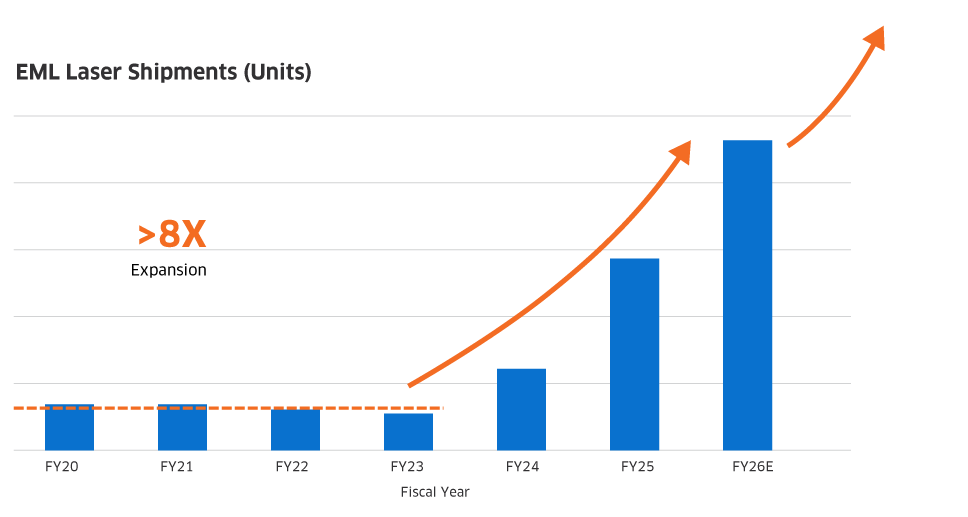
Figure 1. Lumentum OFC 2026 Investor Briefing summary of EML laser shipment growth and committed EML unit capacity addition3.
Move further into the network and the light source itself changes. Silicon photonics engines used in NPO and CPO split the light source and the modulator into two separate devices: a continuous-wave (CW) laser supplies steady light, and a separate modulator writes the data onto it. Lumentum supplies CW lasers for that role, out of its InP manufacturing fabs3.
Push the optical engine closer to the switch ASIC and the laser can come out of the engine entirely, moving into an external, faceplate-pluggable module such as an ELSFP. That external laser source (ELS) approach keeps laser heat away from the ASIC package while keeping the laser field replaceable, even as the rest of the optical engine gets harder to service. Lumentum's ultra-high-power (UHP) laser platform targets that role. Performance data Matt Sysak, CTO of Lumentum presented showed more than 350 mW of optical output at 50°C, power conversion efficiency above 20 percent, linewidth under 500 kHz, and relative intensity noise below -147 dB/Hz at up to 400 mW4, the kind of headroom an external source needs to feed a dense optical engine without becoming a heat problem in its own right.
None of these works without manufacturing scale, and scale here means more than unit volume. It means holding yield and performance steady across that volume, qualifying the same laser platforms for pluggable, NPO, and CPO customers alike, and doing it on a timeline that keeps up with how fast scale-out architectures are changing. Together, these technologies let Lumentum support multiple optical implementations as AI networks evolve.
What Changes, and What Doesn't
The physical location of the optical engine keeps moving from the front panel, to positions closer to the switch ASIC, to near-package integration, to fully co-packaged designs. What doesn't move is the underlying job. Photons still have to be generated efficiently, modulated at very high speed, transmitted with low loss, detected accurately, and manufactured reliably at the scale scale-out networks now demand. Which architecture wins in a given part of the network will matter less than which suppliers can actually deliver that performance and manufacturing scale.
Conclusion: A Roadmap Across Transition
Going from sub-100G links through 100G- and 200G-per-lane pluggables to NPO and CPO isn't one switch flipping from one architecture to another. It's a layered shift, and different parts of the scale-out network are moving through it at different speeds for different reasons. A supplier's advantage doesn't come from correctly guessing which single architecture wins. It comes from being able to support multiple stages of that roadmap at once, and from manufacturing the underlying components at the scale AI infrastructure now requires.
References
1) LightCounting, Cloud Data Center Optics, July 2026.
2) LightCounting, OFC 2026: Bringing Order to AI's Scaling Challenges (Research Note), March 26, 2026.
3) Lumentum, Illuminating the Networks of Tomorrow: OFC 2026 Investor Briefing, March 17, 2026.
4) Matt Sysak, VP, CTO Cloud and Networking, Lumentum, "High Power Lasers for Co-Packaged Optics," LightCounting Tracking Progress in Co-Packaged Optics Virtual Conference, July 15, 2025.