
The New Photonics Ecosystem for the AI/ML Infrastructure
OFC 2026 Takeaways, Part 1 – Event and Market Trend Overview
 April 28, 2026
Loukas Paraschis
Vice President of Business Development

With close to 18,000 registered attendees and more than 700 exhibiting companies, OFC 2026 was the most widely attended in recent history. More than any single attendance metric, however, OFC 2026 proved particularly exciting — at least in my view — for the breadth and depth with which it covered the emerging photonics ecosystem optimized for AI/ML infrastructure. It also established clearly that the transition to this new ecosystem is now underway.
Expanding Optical Connectivity: From Scale-Out to Scale-Up
In many respects, the excitement around OFC began the week before the conference, with several important announcements. Among these, the OCI MSA by Meta, Microsoft, OpenAI, and others was probably the most significant. It defined a new generation of 50G NRZ per wavelength interconnects optimized for scale-up clusters, an entirely new optical use case that is currently served exclusively by copper. Optical scale-up is set to expand optical bandwidth from GPU by nearly an order of magnitude, beyond its traditional role in scale-out and scale-across architectures.
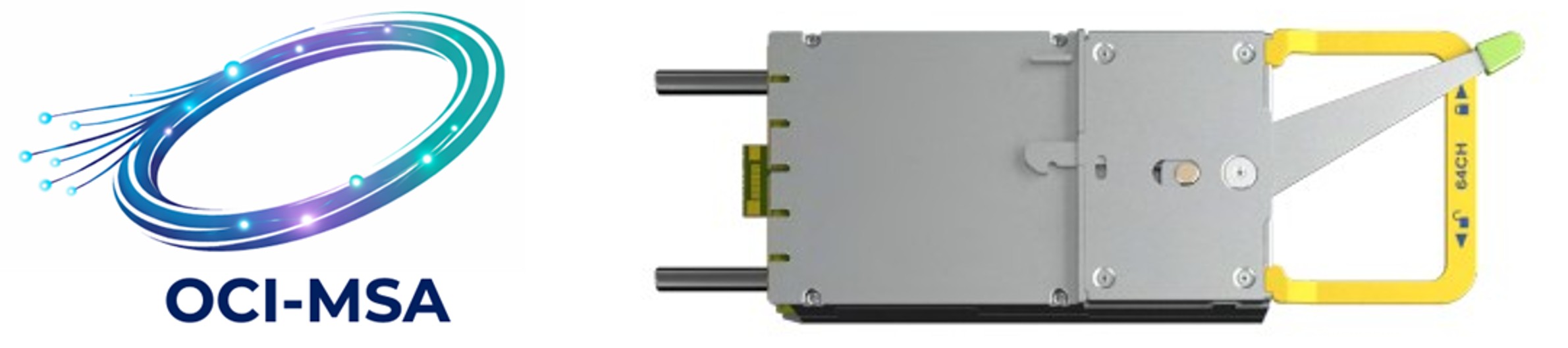
Image1: OCI-MSA | Image 2: XPO module
In addition to the OCI MSA, several other optical technologies were introduced as promising solutions for scale-up, including a slow-and-wide interconnect system based on widely available 3D-sensing VCSELs. At the same time, there were important announcements on the scale-out side, including the first demonstrations of multiple optical channels operating at 400G PAM4 in a pluggable form factor, as well as additional momentum behind 200G PAM4 CPO and NPO initiatives such as the Open CPX MSA. High-capacity pluggable modules like the 12.8T XPO also drew attention — a capacity that, just a few years ago, would have been an entire Tomahawk 3 data center switch.
Challenges and Path to Deployment
Alongside the enthusiasm for these new optical technologies and their surrounding ecosystems, discussions at OFC also highlighted several system- and network-level challenges that must be addressed before widespread deployment can occur. These topics were explored extensively in multiple forums, including an OCP panel (organized by Vladimir Kozlov from LightCounting) and an IEEE panel (which I organized), both held on the same day. As several speakers from major hyperscalers emphasized, total cost of ownership (TCO) will ultimately determine the pace of adoption for this new ecosystem. These system considerations are becoming even more critical with the upcoming transition to next-generation SerDes, nominally referred to as 400G. A range of compelling technology directions is under consideration in this transition, many of which will undoubtedly become topics of our future discussions.
Finally, another critical requirement repeatedly emphasized in OFC discussions was the need to scale manufacturing capacity for optical technologies to meet the anticipated increase in demand as the industry shifts from copper to optical scale-up interconnects over the next two to three years.
In this sense, even for those of us who experienced the highly dynamic OFC conferences that explored the growing role of optical interconnects during the early internet era 25 years ago — and later in cloud and DCI infrastructure 10-15 years ago — this was an even more exciting moment to be part of OFC.
To explore how the trends discussed above translate into real technology, read the next blog in this series: Enabling the Next Phase of AI Optical Infrastructure: From Industry Shifts to Technology Implementation.