
Scale-Up Is Bringing Light Closer to AI Compute
 October 30, 2026

Matt Sysak
Chief Technology Officer

Scale-up keeps accelerators working as one system
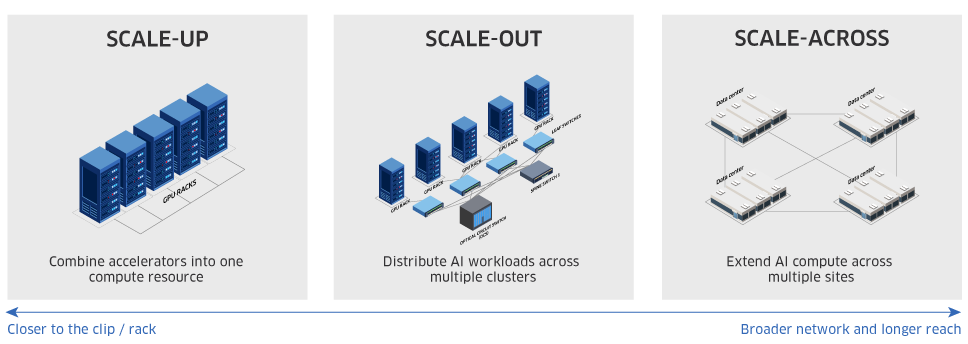
While scale-out connects compute across clusters and scale-across connects systems across sites, scale-up addresses a different challenge: connecting multiple racks so they can function as one coordinated compute system. As AI systems grow, those links extend beyond a package or server to boards, trays, and racks. The design must deliver more bandwidth while managing reach, power, heat, latency, and serviceability. The central question is where optical connectivity can help keep data moving without limiting the system around it.
Bandwidth density matters as much as bandwidth
Aggregate bandwidth is only part of the challenge. Scale-up systems need high bandwidth at the package edge, with low energy per bit and without adding unacceptable latency or operational complexity. As electrical channels get faster and more numerous, signal loss, retiming, power, and heat become harder to manage. Dense packaging also leaves less room for electrical conditioning and cooling. System designers must decide where to place optical engines, how to distribute bandwidth across channels, and how to keep links reliable and serviceable.
Slow and wide adds capacity in parallel
One approach is to increase aggregate bandwidth by using more optical channels at moderate per-channel rates. This “slow-and-wide” approach can provide high total capacity through parallel lanes, as lane rates continue to evolve. Wavelength count, optical-engine density, fiber routing, and the electrical interface can all be tuned to a system’s requirements. It is one design path among several, rather than a single blueprint for every scale-up fabric.
External lasers increase wavelength density
At ECOC 2026, Lumentum demonstrated an eight-wavelength DWDM External Laser Small Form Factor Pluggable (ELSFP) module using its InP-based Ultra-High-Power (UHP) laser platform. The module’s optical interface is designed to meet applicable OCI MSA requirements. In CPO and NPO architectures, an external laser source can supply light to optical engines placed close to compute or switching devices, while remaining independently accessible for service or replacement. DWDM carries multiple wavelengths through a compact optical interface, helping address bandwidth density where package-edge space and fiber routing are constrained.
VCSELs bring high-volume parallel optical links closer to compute
A different path uses 1060 nm VCSEL arrays and multimode fiber to create many parallel optical channels. At ECOC, Lumentum, Qualcomm, and Corning demonstrated a board-level optical die-to-die architecture using 32 Gb/s NRZ channels. The proof-of-concept was designed to show how a massively parallel link could support future CPO and NPO implementations. At the 2026 OCP Global Summit, Lumentum, Astera Labs, and Corning demonstrated fully operational PCIe-over-optics links in a rack-representative arrangement. The proof-of-concept used multiple 32 Gb/s NRZ optical channels over multimode fiber and demonstrated an error-free PCIe 5 link. Together, the ECOC and OCP demonstrations illustrate two different applications for parallel VCSEL connectivity, from board-level die-to-die links to rack-scale PCIe connectivity. They show working architectures, while system-level qualification and deployment remain specific to each application.
Different technologies serve different system needs
These are complementary options serving different architectural needs. Lumentum’s InP-based continuous-wave (CW) and UHP laser platforms support high-power, wavelength-dense optical engines, including external laser source designs for CPO and NPO. VCSEL arrays complement these solutions with many parallel channels over multimode fiber for short-reach links, including board- and rack-level applications. CPO and NPO describe ways of placing optical engines near compute or switching devices, while an external laser module keeps the light source separate from the highest-temperature area and independently serviceable. Optical circuit switching serves a different role: it changes connections at the fabric level.
Designed for deployment
Scale-up links must work in systems that can be manufactured, monitored, maintained, and qualified at volume. Lumentum’s InP laser portfolio includes CW and UHP platforms, with the UHP platform already in production. In parallel, its VCSEL manufacturing base has shipped billions of emitters for 3D sensing applications, providing a high-volume foundation for a different kind of optical link. Lumentum also brings an established MEMS platform for optical circuit switching. These distinct manufacturing capabilities support a broad optical portfolio, while each new scale-up application still requires its own system-level qualification.
Scale-up will take more than one architecture
No single optical design will fit every scale-up link. The right choice depends on distance, bandwidth density, energy per bit, latency, packaging, and operating requirements. InP-based CW and UHP laser sources can support wavelength-dense optical engines, while VCSEL arrays provide a complementary option for highly parallel, short-reach links. Together, they show how AI scales on light: by matching each optical link to its job, from tightly coupled components to larger accelerator fabrics.